


When you first start saving for retirement, you need to decide where to keep your funds, along with the rules and limits of that account. For individual retirement accounts (IRAs), you can choose from traditional and Roth account types. Each has specific contribution limits, income limits and tax rules. Below, Ally Financial outlines what you need to know.
What are IRA contribution limits?
Because IRAs are a tax-advantaged account, the government sets limits on the amount you can contribute each year. Income and deduction limits also change annually due to inflation and new legislation passed by Congress.
The difference between a Roth IRA and a traditional IRA
Your money grows tax-deferred with a traditional IRA, which means you pay taxes on it when you withdraw money during retirement. On the other hand, you contribute after-tax earned income with a Roth IRA, which means it grows tax-free.
Which one should you choose?
Generally, you could choose a traditional IRA if you:
- Want a tax break now
- Believe you'll be in a lower tax bracket in retirement
You should choose a Roth IRA if you:
- Want tax-free income in retirement
- Believe you'll be in a higher tax bracket in retirement
- Want the flexibility to withdraw contributions before retirement without penalty
You should consider both accounts if you can afford to, as this can provide tax diversification in retirement.
Roth IRA vs. traditional IRA contribution limits for 2026
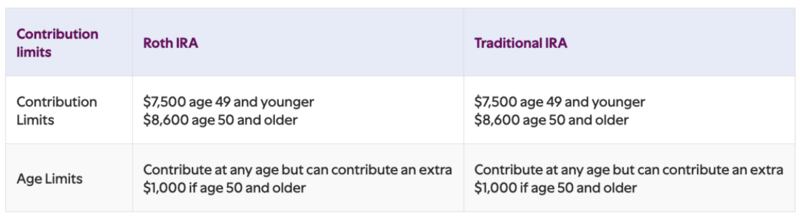
Stay on top of the following current IRA contribution, income and age limits, so you can take full advantage of your IRA without being penalized for contributing too much. Make sure you're aware of potential IRA missteps that could impact your retirement savings.
Ally Financial
Note: You can contribute to both Roth and traditional IRAs, but total combined contributions can’t exceed these limits.
Income limits for Roth IRA vs. traditional IRA
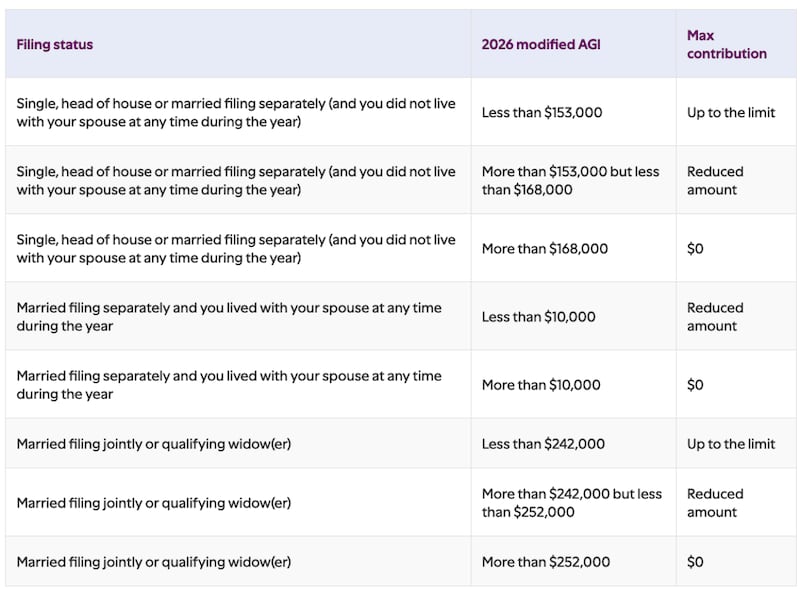
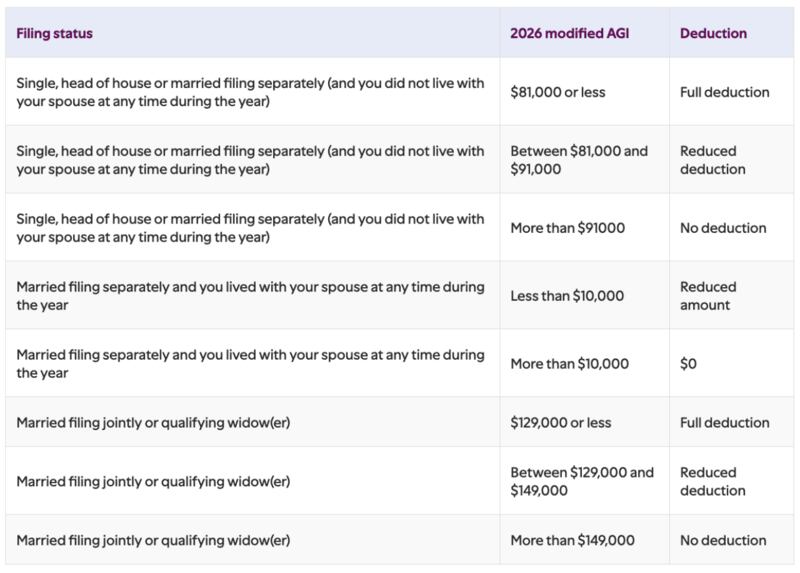
With a traditional IRA, income limits determine whether you can deduct your traditional IRA contributions. If you or your spouse has a retirement plan through an employer, your ability to deduct might change. If you have a Roth IRA, your contribution will not be deductible — but income limits do determine your maximum annual contribution.
The charts below will help you figure out where you stand. You'll need two pieces of information: your filing status and your modified adjusted gross income (which you can figure out using the instructions provided in IRS Publication 590-A).
Roth IRA income limits for 2026 contributions
The most common IRA contribution guidelines — based on adjusted gross income (AGI) — for 2026 include:
Ally Financial
Traditional IRA deduction limits for 2026
With a traditional IRA, the income limits below are only applicable if you are covered by a workplace retirement plan. The limit is based on modified adjusted gross income after considering certain allowable deductions and tax penalties.
Ally Financial
Note: Traditional IRA contributions may be fully or partially deductible depending on your income and workplace retirement plan coverage.
What happens if I contribute too much to my IRA?
If you exceed the limit, you typically have until the filing deadline to fix the mistake (or Oct. 15 if you’re filing an extension). You can contact your plan administrator to help file the appropriate paperwork and remove the excess contribution. For every year the excess amount stays in your account, you’ll have to pay a 6% penalty on the overcontribution.
How to maximize your IRA contributions
Get the most out of your retirement savings by taking strategic steps to help optimize tax advantages and long-term growth.
1. Contribute early
Setting aside money in your IRA earlier in the year — rather than waiting until April of the following year to make a prior-year contribution — can allow your money to compound, which can add up over time.
2. Diversify tax advantages
Traditional and Roth IRAs offer different tax advantages, so having both types of accounts can diversify the benefits you receive.
3. Review and adjust
Ensure your IRA aligns with your financial goals, risk tolerance and income by regularly reviewing and adjusting your contributions each year.
4. Get ahead on your contributions
Knowing the limits of any account is important as you work toward being well-prepared for retirement. Whether you choose a traditional or Roth IRA, opening a tax-advantaged retirement account is a smart step to getting serious about saving for those golden years.
Prepare for 2026 IRA contribution limits
The 2026 IRA contribution limit is $7,500, or $8,600 if you're age 50 or older. This cap applies across all your IRAs combined and must be met by April 15, 2026. Be aware that income limits may affect your eligibility for Roth contributions or traditional IRA deductions, and exceeding the limit triggers a 6% annual penalty.
This story was produced by Ally Financial and reviewed and distributed by Stacker.