

"The emotions involved are not for the faint of heart," says just one of 1,144 family caregivers from the 2026 Caregivers in Crisis survey conducted by Aeroflow Urology.
Today, nearly one in four adults in the U.S. is a family caregiver.
For them, supporting a loved one means providing daily assistance, often unpaid, while trying to keep up with the nation’s rising cost of housing and groceries.
Many are also part of the “sandwich generation,” caring for aging loved ones while raising their own young children.
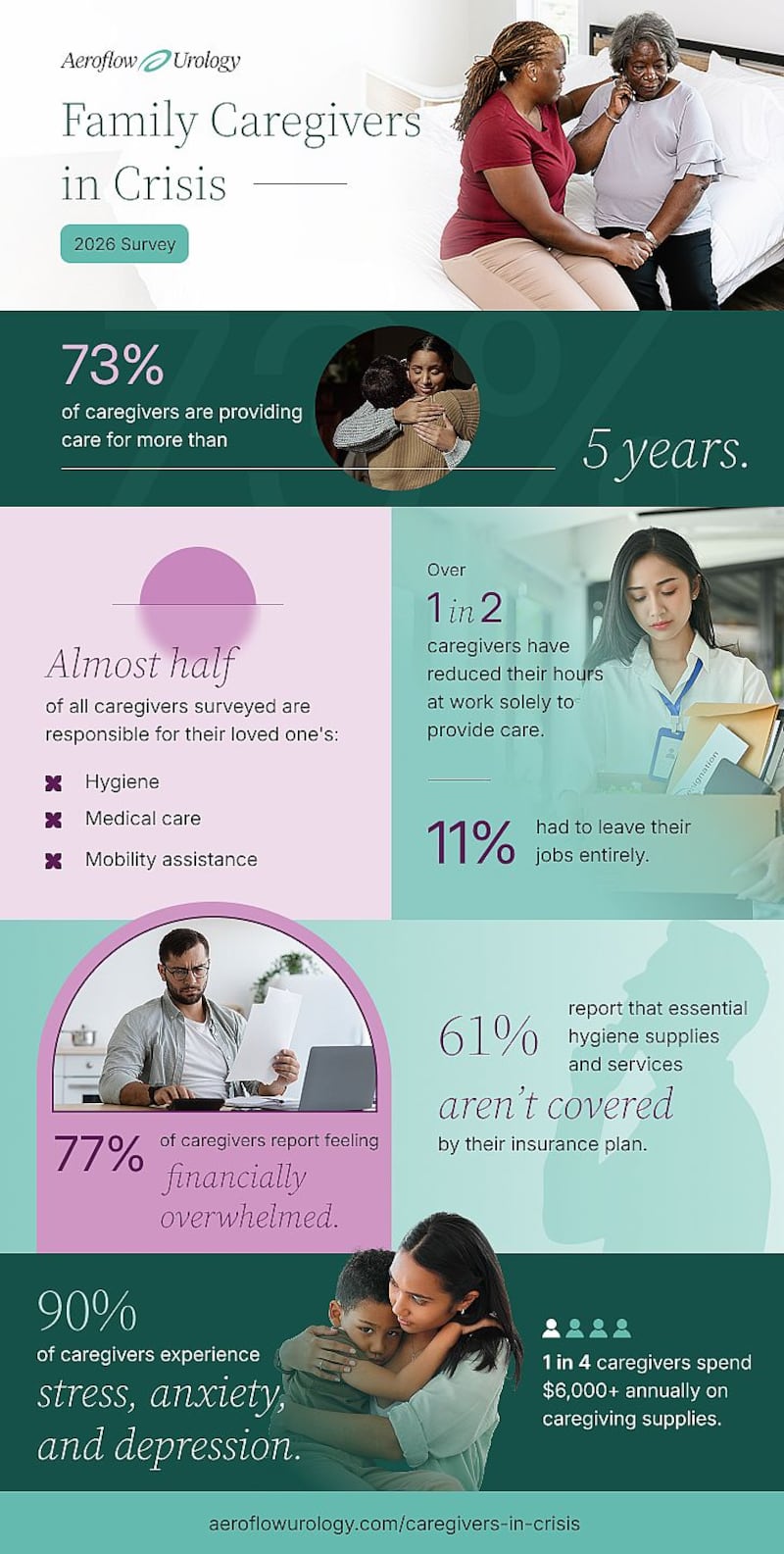
A disturbing 57% of the caregivers surveyed said they’ve reduced their work hours just to be able to care for their loved one, and 11% quit their jobs altogether.
These challenges are extending far beyond individual households, with implications for public health and the broader U.S. economy.
Currently, the Centers for Disease Control and Prevention (CDC) recognizes caregiving as a public health issue, and AARP's report, Valuing the Invaluable 2026, finds that families are already contributing more than "$1 trillion in economic value."
How can America solve this crisis?
Key Takeaways:
- More than half (57%) of U.S. family caregivers say they've reduced their work hours just to care for their loved one, and 11% quit their jobs altogether.
- Up to 90% of family caregivers report feeling that they've recently experienced stress, anxiety, or depression, while one in five say they're operating solo, with no help from friends or family.
- "Everything is impacted. My money, my time, my family, my job, everything," says one respondent. Another highlights the unseen demands: "It's a full-time job with perpetual overtime."
- A total of 77% surveyed said they feel financially overwhelmed by caregiving costs. With 63 million family caregivers, this population now makes up nearly a quarter of the total U.S. adult population — all during a time of increasing economic uncertainty.
Are You Considered a Family Caregiver?
A family caregiver helps a loved one who needs extra support due to age, illness, disability, or a health condition.
This can include your:
- Parent
- Spouse
- Child
- Grandparent
- Sibling
- Extended family member
According to the AARP, the vast majority of caregivers provide care for adults, dedicating an average of 27 hours a week to their role.
For many, the price to pay for this care is as emotionally taxing as it is financially draining.
“It’s a full-time job with perpetual overtime,” says one family caregiver from the Caregivers in Crisis survey.
Another expressed the totality of their situation, stating, “It’s very isolating and lonely. You want what’s best for your loved one, but especially if there is cognitive decline, there’s just… no escape. You live where you work, while also grieving loss after loss of the person you love, of a personal life, and guilt about all of it.”
The lack of support runs deep.
Nearly one in two individuals surveyed reported that they’re responsible for high-intensity tasks, like daily hygiene and mobility assistance, without receiving any formal medical training.
Meanwhile, many juggle their caregiving responsibilities on top of a full-time job.
How does this affect care recipients? Nearly 60% of caregivers said their loved one experienced “serious complications from not receiving enough care.”
Medical professionals find the data concerning.
Board-certified pediatric nurse practitioner Dr. Samantha Eaker, DNP, CPNP-PC, states, “This finding should be viewed as a preventable downstream effect of coverage gaps.”
“Unacceptable,” says Aleece Fosnight, medical advisor for Aeroflow Urology.
Rising Costs Force Caregivers to Make Unimaginable Decisions
“It's extremely anxiety-inducing. Your loved one solely depends on you for their care and to meet their needs. It's also severely taxing on someone's mental health and personal life,” one family member shared.
These concerns align with emerging evidence.
New data from a 2025 review suggests that chronic stress can negatively impact the immune system.
Healthcare professionals bring light to the statistics: "We know that caregiver burnout isn't just an emotional issue,” says Fosnight, adding that it can even “contribute to poorer patient care, increased complications, and higher overall healthcare utilization… it costs the system more in the end when we don't put those resources in at the beginning of care as a preventative approach.”
Many are also falling through the cracks of a systemically flawed healthcare system. One caregiver notes, “[My family was] labeled as ‘too rich’ to need help… anything that helps the caregiver is considered uncovered by the insurance company, most things required to keep [my loved one] clean and healthy (i.e., free from infection) are not covered.
“They took away the assistance she got for food because we pooled our resources as a family and cooked together to save money. She can never move out because we would have to dump her at a homeless shelter before [the government] would offer assistance.”
Leading Caregiving Advocate Speaks Out
Jessica C. Guthrie is a full-time carer for her mother with Alzheimer's disease and a leading caregiving consultant. Her experiences as a caregiver have been featured in publications such as Business Insider.
“77% of caregivers are financially overwhelmed, 57% reducing their work hours, 90% experiencing stress, anxiety, or depression,” she told Aeroflow Urology
“These are not abstract figures to me, they are the lived experience of an only child who became her mother's primary caregiver at 26 with no roadmap and no backup. What this data confirms is something I have spent years advocating for: Caregiving is unpaid, often invisible labor that touches every part of a person's life, financially, emotionally, and physically.”
Aeroflow Urology
Families Deserve a Clear Path to Caregiving Support. Here’s How.
The data is overwhelming, but there isn't a transparent process for even accessing support across all 50 states, let alone paid caregiving.
Hidden behind a maze of bureaucratic idiosyncrasies, support feels almost deliberately obscured.
Beyond idle words, family caregivers in the U.S. need action, but where do we start?
1. Simplify How Healthcare Teams Connect Families to Resources
Up to 89% of caregivers surveyed say they wish their doctors provided more assistance and resources.
This comes as the Federal Reserve recently raised its benchmark interest rate for the first time since 2023 to help combat high inflation.
In a brief from July 2026, the Urban Institute also reported that nearly one in four working-age adults "used credit cards to purchase food for their families and experienced repayment challenges."
There is a substantial gap for healthcare professionals to bridge, but it can begin with a targeted, coordinated effort to gather resources.
Healthcare providers can help connect families to critical resources by starting the conversation and asking who is there to help at home, including pointing them in the direction of trusted resources, such as:
2. Make Paid Care Easier to Access
Caregiving can be incredibly meaningful, but there's no denying that it can impact income.
While paid family caregiver programs are available across the country, the rules vary by state, and many caregivers report that they don’t know where to even begin: “I wish I knew how to apply to become a paid caretaker. In doing so, I could afford to take proper care of my father, who has end-stage renal disease,” one caregiver stated.
Another shared a similar frustration: “There is not enough guidance to navigate the healthcare system.”
The rate of unpaid care is even more staggering.
Recently, the Alzheimer's Association disclosed its 2025 Disease Facts and Figures report and found that unpaid dementia caregiving was valued at $413.5 billion.
As continued cuts to Medicaid and Medicaid work requirements are beginning to take effect — in some states, even earlier than the outlined January 2027 deadline — many families face growing uncertainty about navigating an already strained system.
How Can the U.S. Fix the Caregiving Crisis?
At some point in our lives, we may become caregivers, whether a spouse needs help recovering from an illness, a parent falls, or a child is born with a disability and needs care into adulthood.
For millions of Americans, this isn’t a distant reality.
The country's population is aging, and by 2030, all baby boomers will be 65 or older, which could drive demand for caregivers even higher and leave Gen X and millennials scrambling.
Yet, for many, caregiving is less an obligation, but more an obvious choice to give back to the people they love.
In the words of one caregiver, their role is “stressful… financially challenging, but worth it to take care of my husband instead of being in an institution.”
This story was produced by Aeroflow Urology and reviewed and distributed by Stacker.